
When people think of the Arts and Culture category of the UK Global Talent visa, the first names that usually come to mind are musicians, actors, painters, writers or other artists who are directly visible on stage. As a result, many creative professionals who play an important role in bringing an artistic work or performance to life, but who do not appear before the public directly as an “artist”, may assume that this route is not an option for them.
However, assessment under the Global Talent Arts and Culture route is not limited to people who are seen on stage, in an exhibition or at the front of a work. Within the art disciplines supported by Arts Council England, certain creative and supporting roles that contribute to the creation and presentation process may also fall within the scope of assessment.
The current Immigration Rules do not build the assessment in the Arts and Culture field solely on work produced by the individual alone. Work carried out by the applicant as a named member of a group, or as a contributor to the work of another artist or group, may also be considered, provided that certain requirements are met.
For this reason, the key issue for behind-the-scenes creative roles is not so much the person’s visibility in the project, but the nature of the professional contribution they make to the relevant art discipline and how that contribution can be evidenced.
In this article, we look at how the UK Global Talent Arts and Culture route is assessed for professionals working in creative and supporting roles behind an artistic work or performance.
Can Behind-the-Scenes Creative Roles Fall Within the Scope of Global Talent?
As of September 2026, Arts Council England assesses endorsement applications in the fields of Combined Arts, Dance, Literature, Music, Theatre and Visual Arts. In the relevant field, a person may be assessed as having Exceptional Talent, meaning a leader in their field, or Exceptional Promise, meaning a professional with the potential to become a leader in their field in the future.
Under the Immigration Rules, the applicant must be professionally involved in the production of high-quality work, show a regular professional connection with their field within the last five years, and demonstrate sufficient professional history according to the type of application.
However, the current rules do not require this work to be produced by the person alone and under their own name. In the core evidence categories such as media recognition, international awards and professional appearances, the rules allow a person to present their work individually, and also as a named member of a group or in the capacity of a contributor.
Therefore, the fact that a person does not appear on stage or is not the main performer of a work does not, on its own, mean that they fall outside the scope of the Global Talent visa.
What Does Being Assessed as a “Contributor” Mean?
Artistic production is often not the work of a single person.
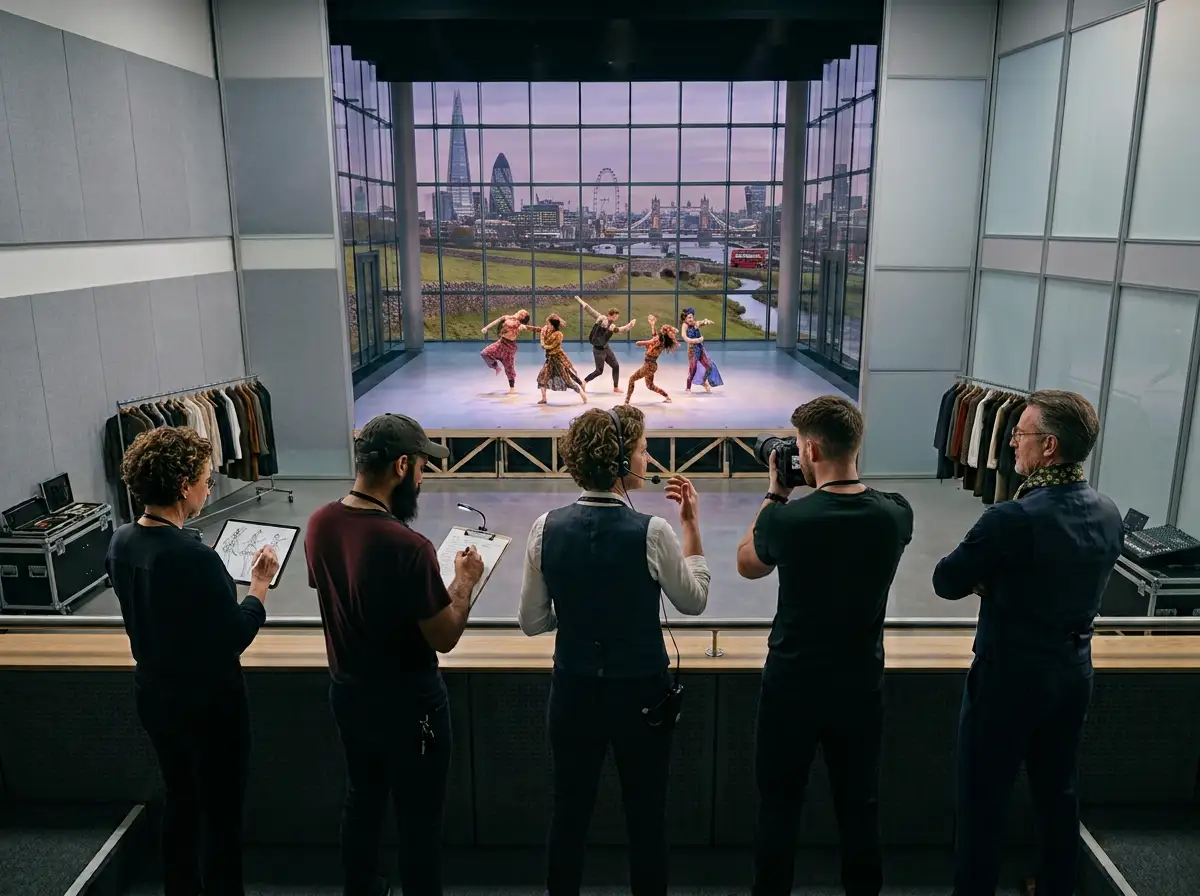
A concert does not come about solely through the performance of the musician on stage; a theatre production is not limited to the actors; and a multidisciplinary event is not limited to the artist named on the poster. The visual language, stage structure, narrative, lighting, costumes, production or other creative elements of a work or performance may come about through the contributions of different professionals.
For the Global Talent visa, in some cases this contribution can become the key to a positive outcome.
For example, under the discipline guidance published by Arts Council England, in the field of theatre it is not only actors who may be assessed; producers and directors, playwrights and dramaturgs, lighting, set and costume designers, and certain stage crew roles that contribute to the creation and presentation of a production may also be considered.
Similarly, in the field of Combined Arts, roles such as director, producer, lighting designer, festival programmer, organiser and curator that contribute to the creation or presentation of multidisciplinary artistic work may also fall within Arts Council England’s area of assessment.
The common point here is not the job title, but the connection between the person’s work and the supported artistic practice.
That said, taking part in an arts or culture project does not, on its own, mean that the Global Talent criteria are met. Working with a well-known artist, being part of the team on a major production or holding a particular professional title is not, on its own, decisive for the assessment.
For Arts Council England, what matters is the professional practice the person actually carries out, how that practice connects with one of the supported art disciplines, and the nature of the contribution the applicant makes to the creation or presentation process.
For this reason, while some roles described as technical or supporting may be considered within scope, activities that remain purely administrative, commercial or organisational in nature may not be treated in the same way. The assessment is carried out on the basis of the concrete nature of the work done, rather than the job title.
The Foundation of the Application: Evidencing Creative Contribution
For behind-the-scenes creative roles, one of the most important points in a Global Talent application is that the contribution made to the relevant project can be clearly linked to the applicant.
A production may have been widely covered in the international press, but the coverage may mention only the artist on stage. A concert may have taken place at a major festival, but the poster may not include the name of the creative director, costume designer, set designer or lighting designer.
In such cases, the success of the project cannot automatically be attributed to the applicant. The rules allow a person’s contribution to the work of another person or group to be taken into account in certain evidence categories. However, the link between the applicant’s role in the relevant work and the success or recognition presented must be evidenced.
For this reason, in a Global Talent visa application, rather than simply saying “I took part in this project”, it is important to answer the following questions:
- what exactly the applicant’s role in the project was
- what creative or professional contribution they made
- on what date and in which country the work took place
- whether the applicant’s involvement in the project can be shown through independent or verifiable documents
- whether a sufficient link can be established between the media, event, award or other evidence and the applicant’s work
The same principle applies to media recognition. In Arts Council England’s practice, if a person does not have individual media recognition, media recognition relating to the work of another person or group to which they contributed may be used in some cases. However, simply submitting the relevant news article or review is not enough; the applicant’s contribution to the featured work must also be demonstrated. For example, the fact that an extensive review of a concert was published in an international publication does not mean that the costume designer of that concert has automatically achieved media recognition.
There is a similar provision for awards. In Exceptional Talent applications, the rules accept as one of the evidence categories not only having personally won an international award, but also, under certain conditions, having made a significant contribution to winning an international excellence award. For Exceptional Promise, the scope is wider; in certain cases, a significant contribution to winning an award, a nomination or a shortlisting may also be taken into account. However, this provision does not mean that everyone who worked on an award-winning project can use that award in their own application. The critical concept here is significant contribution; the relationship between the person’s role in the project and the winning of the award must be demonstrated with sufficient weight and appropriate documents.
How Can Creative Contribution Be Documented?
According to the current guidance, the applicant may submit up to ten pieces of evidence covering at least two of the three evidence categories (media recognition, international awards, professional appearances). Each piece must be no more than two A4 pages and must fall within the last five years counting back from the date of application. Because of these limits, in long programme booklets or multi-page reviews, the sections in which the applicant’s name and role appear need to be highlighted.
The application must also include three letters of recommendation. Two of the letters must be from expert, established organisations in the field, at least one of which must be based in the United Kingdom; the third letter may be obtained from an organisation or an individual expert. Each letter must be no more than three A4 pages long, signed, dated and must demonstrate the author’s own seniority.
For professionals working behind the scenes, letters of recommendation can be more decisive than in artists’ applications. Rather than praising the applicant’s general qualities, the letter is expected to describe their concrete contribution to specific productions, the creative decisions they made and the effect of those decisions on the outcome.
Do the Same Rules Apply in Film, Fashion, Architecture and Design?
There are several specialist assessment fields under the Global Talent Arts and Culture umbrella, and their criteria are not the same.
As of September 2026, Arts Council England directly assesses the fields of Combined Arts, Dance, Literature, Music, Theatre and Visual Arts. Applications in film, television, animation, post-production and visual effects are subject to specialist assessment by PACT; fashion design applications by the British Fashion Council; and architecture applications by RIBA.
In addition, according to the list on gov.uk dated 1 July 2026, Design Industry is also included within Global Talent, and the specialist assessment of applications in this field is carried out by the Design Business Association.
For this reason, it would not be correct, for example, to place a professional who designs costumes for theatre and a fashion designer who designs fashion collections in the same category simply on the basis of the word “design”.
Similarly, theatre production and film production are separate fields for the purposes of Arts Council England’s assessment.
What Is the Difference Between Exceptional Talent and Exceptional Promise?
There are two endorsement levels in the Arts and Culture field. In both categories, the applicant must have carried out regular professional activity in their field within the last five years.
Exceptional Talent is for professionals who are already recognised as leaders in their field. The applicant must demonstrate a substantial track record in at least two countries.
Exceptional Promise is for people at an earlier stage of their career who show the potential to become leaders in their field in the future. In this category, a developing track record may be demonstrated in at least one country.
In both categories, having professional experience alone is not enough. The applicant must demonstrate their recognition and professional work with appropriate documents within the framework of the relevant endorsement criteria.
Common Mistakes for Behind-the-Scenes Creative Roles
1. Presenting the organisation’s success as personal success. Awards and reviews received by the theatre, festival or production company the applicant worked with do not count as the applicant’s evidence unless the applicant’s name and role are documented.
2. Listing uncredited work. Contributions that do not appear in the credits remain weak unless they are supported by confirmation letters obtained afterwards.
3. Choosing the wrong discipline or endorsing body. Stage production, film production and the design industry are assessed by different organisations and against different criteria.
4. Treating the job title as evidence. A Creative Director or Producer title may help in understanding the field of activity; however, the assessment is based on the professional practice actually carried out.
5. Overlooking the five-year window. If the strongest work of a career is more than five years old, it cannot be submitted as evidence; it can only appear in the CV.
6. Treating work with a well-known name as sufficient. Being part of the team of an internationally recognised artist may strengthen the context; however, the evidence through which the applicant’s individual contribution to that production is demonstrated is assessed separately.
Being Behind the Scenes Does Not Mean Being Outside the Scope of Global Talent
UK Global Talent Arts and Culture applications are not assessed solely on the basis of people who appear on stage or at the front of a work. Certain supporting and creative roles that contribute to the creation and presentation of artistic production may also fall within Arts Council England’s area of assessment.
That said, the scope does not automatically include everyone working in the creative sectors. What is decisive is the discipline in which the person works, the concrete role they take on in projects, their professional background and the extent to which these contributions can be demonstrated with appropriate evidence.
For this reason, for behind-the-scenes creative professionals, the nature of the contribution and the ability to evidence it, rather than the job title, are at the centre of the Global Talent assessment.
Do You Work Behind the Scenes of Creative Production and Want to Consider the Global Talent Route?
If you work in a creative or supporting role in stage, concert, theatre, multidisciplinary art or other eligible cultural productions, it is necessary to examine separately under which Global Talent discipline your professional activities may be assessed and how your existing work is positioned against the endorsement criteria.
You can contact Visavis to have your specific professional background, field of work and existing evidence assessed.
Email: team@visavisuk.com
London: +44 7936 910 888
Istanbul: +90 541 968 97 91
Web: www.visavisuk.com
References:
- GOV.UK, Immigration Rules Appendix Global Talent, updated 3 August 2026
- GOV.UK, Work in the UK as a leader in arts and culture, Global Talent visa, Combined arts, dance, literature, music, theatre or visual arts
- GOV.UK, Disciplines covered by Arts Council England or its associated bodies, updated 1 July 2026
- Arts Council England, Guide for Global Talent visa applicants: Arts and Culture, version dated 20 February 2025
Visavis is regulated by the Immigration Advice Authority (IAA). IAA registration number: F202100232. This article has been prepared for general information purposes. It covers the rules in force as of September 2026. Immigration rules, Home Office guidance, application fees and assessment practices may change over time. Each application is assessed on its own circumstances. This content does not constitute legal or immigration advice on any person’s specific circumstances.